
Photograph by John F. Bjorklund, © 2016, Center for Railroad Photography and Art.
Why model the New Line, or as it was officially known, the Connellsville Subdivision of the Western Maryland Railway?
For me, there are many reasons, some sentimental and some are more practical from a modeling sense. However, I think the former outweighs the latter. Let me explain.
I grew up in the heart of Western Maryland Railway territory in Eckhart Mines, Md. The last coal pulled out of the mines was carried by WM power after the WM acquired the Cumberland and Pennsylvania Railroad in the mid 1940's from Consolidated Coal Corp. However, it would be a much later use of the WM and C&Pa that would cement my interest in the WM and railroading in general.
I was too young to know it then, but when I was born, a fledgling operation known as the Western Maryland Scenic Railroad was just getting its footing, after the previous excursion operator (Allegany Central) stopped operating on the line between Cumberland, Md and Frostburg, Md. This may sound hokey now, but I highly doubt I would have developed the interest in railroading that I have, had there not been the sounds of a 2-8-0 climbing the mountain behind my house every weekend. Coming home from church on Sunday, we would often here the sound of "Mountain Thunder" blowing it's whistle as exited the turntable in Frostburg. Most kids my age did not grow up with weekly steam nearby, so I count that as a privilege that has highly influenced my life. Steam engines are certainly not the most cost effective or effective way to move freight and passengers, but they are definitely fascinating beasts.
Fast forward to the early-2000's. My father is working both in and around the former WM Station in Cumberland as part of it's second renovation and transformation into the centerpiece of Canal Place. Again, spending summers exploring the ROW around Cumberland helped to further cement my interest in the WM. Around that time the WMSR faced another impending shutdown in favor of a bike trail that would connect Pittsburgh and the C&O Canal towpath between Washington D.C. and Cumberland. It seems silly now given how well the trail and scenic railroad have worked together, but there were real talks of shutting down the railroad in favor of turning the right of way into a trail.
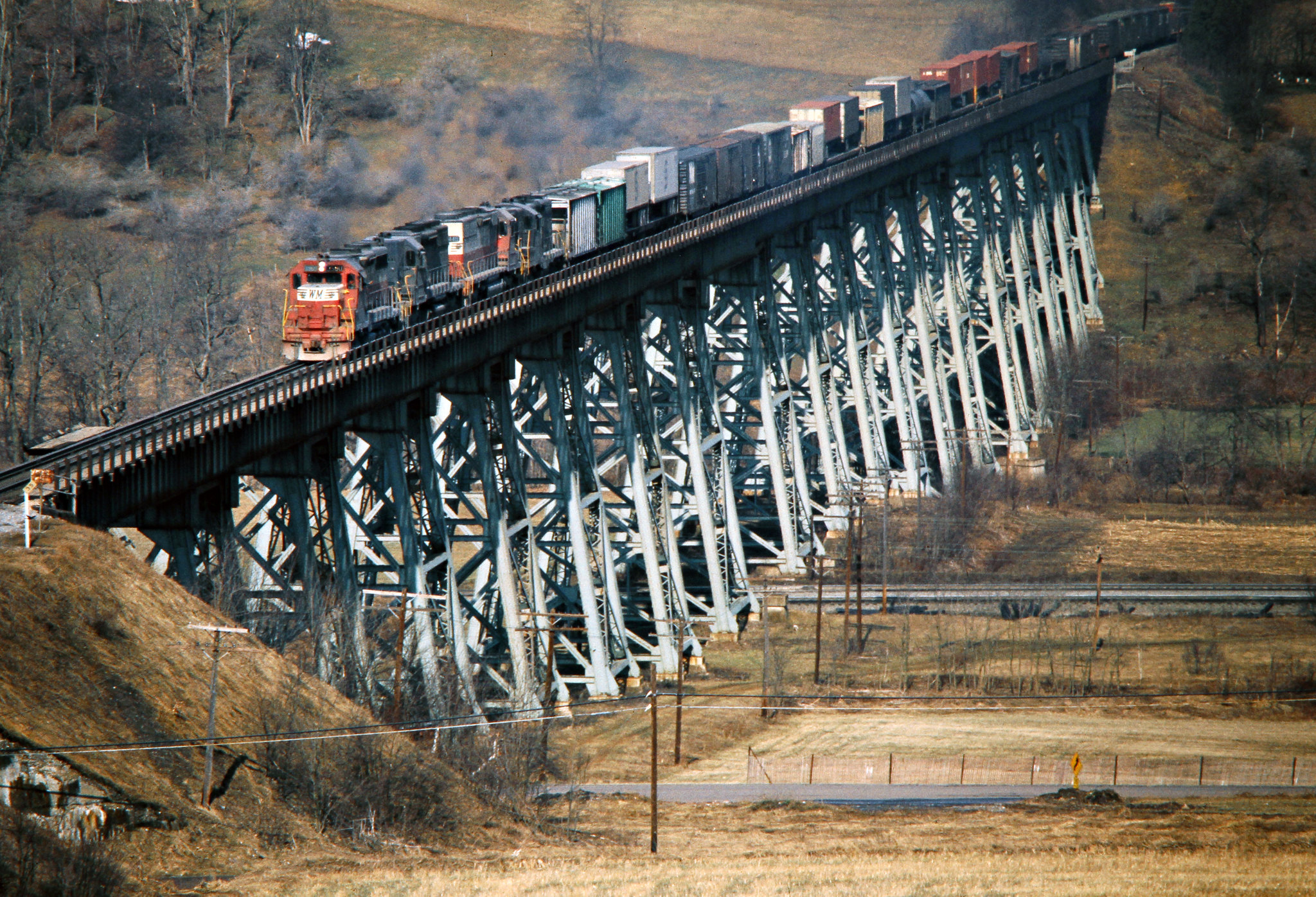
Photograph by John F. Bjorklund, © 2016, Center for Railroad Photography and Art.
The trail was actually already a reality up in Pennsylvania for long stretches, starting first around Ohiopyle State Park and extending to include the WM's longest bridge near Meyersdale, the Salisbury Viaduct. Biking these streches of the former WM made my love for the WM grow all the more.
It is this part of the history of the subdivision that I find most ironic. In May of 1975, a ceremonial "last train" was run along the Connellsville Sub. The trip included the WM business coach 1700, but was led by a B&O GP9 for it's steam generating capability and included one other B&O coach. Part of the reason for this run was to showcase to local dignitaries how scenic the line was and how it might work well as a recreational asset. However, the Pennsylvania DOT had already removed a low clearance span in Ohiopyle, so the train ended up having to detour over the B&O for a section of the ride. Today you can ride from Pittsburgh to Cumberland via the P&LE/WM right of way and still travel along live rails between Frostburg and Cumberland.
Here is where we get into the practical modeling reasons (operations and scenery) that attract me model the New Line.
Up until early May of 1975, the WM and its former Alphabet Route partner Norfolk & Western were using the subdivision heavily to move Alpha Jets, grain extras, ore extras, and coal. If the railroad politics of the day were not known to the casual observer, the heavy mix of N&W power and cabooses on the WM might have lead one to believe the two were headed for a merger of their own.
The subdivision was largely single tracked, with long passing sidings for train meets spaced out along the line. When Gorge Gould began pushing the WM west from Williamsport in the late 20th century, he had grand plans and designed each bridge to be double tracked and many of the tunnels as well. Despite his control of the WM having lapsed by the time the "New Line" commenced construction in 1907, the railway still built every bridge and all but Big Savage tunnel with the capacity to be double tracked. However, only the heaviest grade between Cumberland and Colmar (the railroad designation for Big Savage Tunnel's interlocking) on the east end of the subdivision would ever see double track. With the advent of CTC, controlled out of the Cumberland station, that section double track would be reduced to 3 mile long passing siding between Mount Savage and Frostburg.
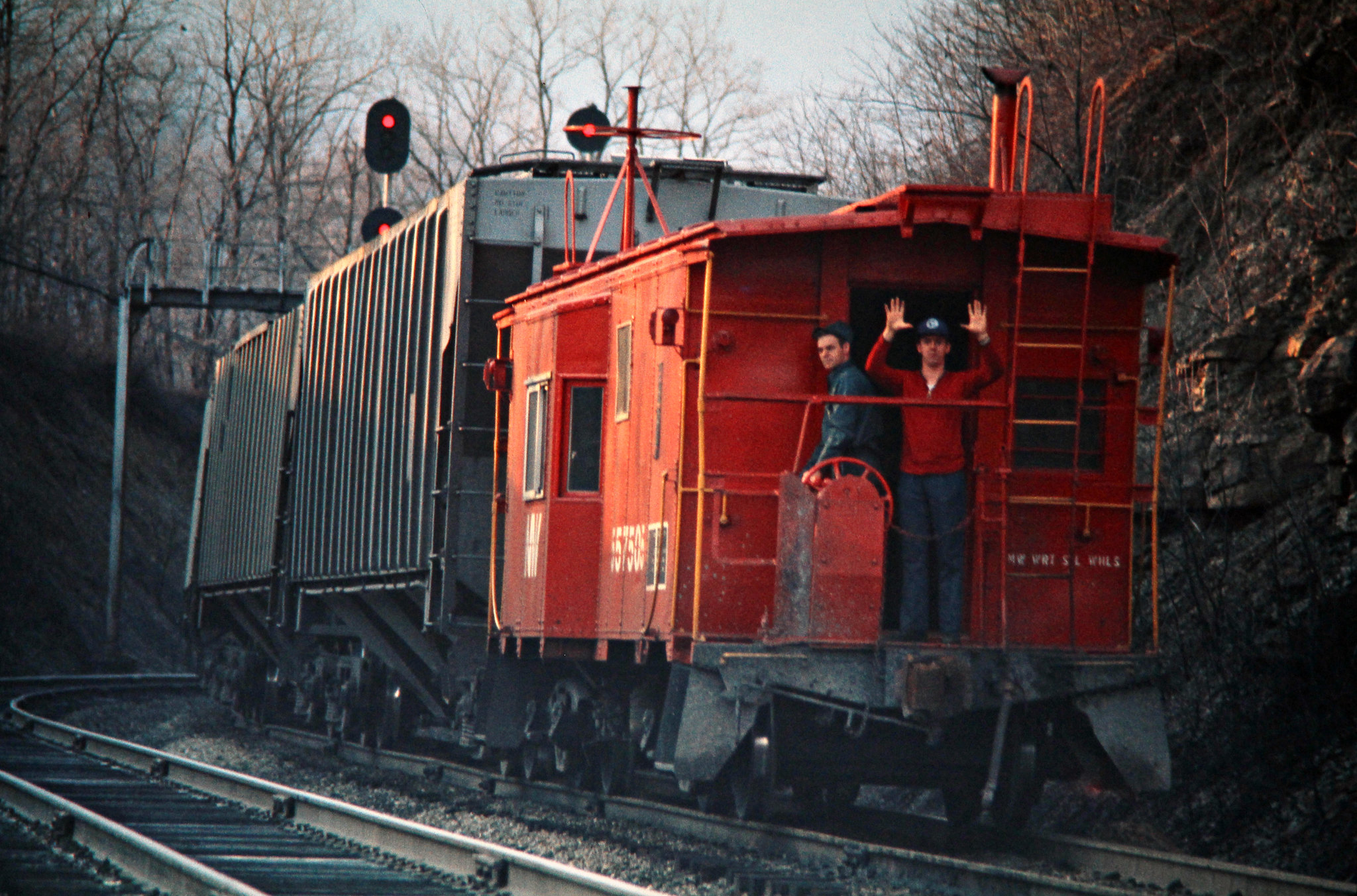
Photograph by John F. Bjorklund, © 2016, Center for Railroad Photography and Art.
From my time at the CB&W Model Railroad Club in Grafton, VA, I found that I really enjoyed mainline operations. The CB&W has over 16 scale mile run length with a mix of single and double track. For open houses and operating sessions, we would have a dispatcher control our movements through the single track sections. From my experience there, I saw how the WM's mix of single track with passing sidings could be duplicated in a similar fashion
The CB&W mainline also passed over itself at times. To some, this might be a non-starter for prototypical-ness, but the WM crossed the B&O four times and was crossed by it once on it's way to Connellsville. It also crossed the C&Pa twice and was crossed by that road twice. There was also a crossing of the PRR at Bowest (Connelsville). In my opinion, this gives me plenty of excuses to run my WM over itself if the need arises during the design.
Personally, running a long train over a long route is the most enjoyable part of the hobby at the moment. Having to space out my run and check switches along the way provides enough operational challenge as well as the general challenge of working up a grade. However, I did not want to be without some switching opportunities, should I need to scratch that itch, or if I have a visitor for whom switching is their favorite part of operations.
Western Maryland in the Diesel Era states that the Connelsville Subdivision was largely devoid of online industries. This is true if one were to take industrial switching as a percentage of the entire length of the line. However, there were at least six significant "branches" of the sub. The State Line branch connecting with the PRR, the Eckhart branch (which still ran as far as LaVale, Md), the former C&Pa stubs to Mt. Savage and Frostburg, the branch over the B&O to Gray, Pa, and the extension over the B&O down to Chiefton, Wv.
As for direct online industries, there were many that lasted into the latter days of the the subdivision, and even kept portions of it open for a time after through trains stopped. There were many customer accounts in the immediate area around Cumberland, served directly or indirectly via the WM's Freight House. There were numerous coal load-outs along the line, particularly the load out for the Blue Lick mine near Meyersdale, Pa. There were also team tracks at each station location along the line, and a WM owned trailer ramp located in the P&LE's West Connellsville Yard. These industries, along with two connections to the PRR/PC and many with the B&O allow for online interchange of traffic in addition to the through traffic handed off at Connelsville to the P&WV/N&W and P&LE.
In the end, the shifting landscape of railroading of the 1960-1980's left the WM's once profitable business model and connections in tatters. To read more on this, I would highly suggest reading the interviews with the President and Vice President of Operations of the WM in Working for the Western Maryland Volume 1. The B&O found a way to keep control of the WM despite the ICC's desire to keep the competitors apart in the 1920's. When the end came, the ICC was letting many competitors combine, so the absorption of the WM by the B&O was all but inevitable. While I can see a version of history where the Connellsville Sub and West Subdivisions could have lived on for a time to serve the N&W and act as competition to the B&O, the N&W's spin off of the former P&WV trackage into the new Wheeling and Lake Erie leaves the long term viability of that idea in question.
For myself, I want to return to the days when engines dressed in red, white, gold and black (but mostly black) pulled Alpha Jets and extras east and west over Big Savage Mountain, with some hamburger/meatball logos thrown in for good measure. I hope you will be willing to join me on this modeling adventure as I attempt to capture the busy last days (or years) of the Western Maryland Railway's New Line.

Photograph by John F. Bjorklund, © 2016, Center for Railroad Photography and Art.

No comments:
Post a Comment